
More than eight months have passed since our last English-language article about the protests in Serbia erupted after the canopy at the Novi Sad railway station collapsed on November 1, 2024. Since then, some of our predictions have come true, but as is often the case, surprise also played a major role.
Cover photo: Burned-out offices of the SNS in Valjevo (Photo: Siniša Obrenić)
We do not have the time to go into all the details of what has transpired from December until now — including the ongoing blockades at both public and private universities, student marches across the country (and abroad), the largest protest in the history of Belgrade, the use of sonic weapons, the fall of the government (which stirred no one), and much more.
If you’re interested in the chronology of all these events, a more than satisfactory article is available on the English Wikipedia.
Instead, we will focus on the summer months and the most recent escalation of events.
We must briefly return to our December predictions: back then, we concluded that the government had three possible responses to the student uprising:
- To call elections,
- To allow the protests to “fizzle out,” and
- To bring the country to the brink of civil war —
with the third option seeming the least likely.
However, the Serbian autocrat Aleksandar Vučić refused to call elections for half a year. This move puzzled some analysts, given that snap elections had often served as his go-to exit strategy in past crises.
By late spring, the students began explicitly demanding that very solution, and the regime’s persistent refusal to acknowledge or act on it led to growing suspicion that its grip on public opinion might be weakening. Rumors soon circulated that the yet-to-be-announced student electoral list was already polling better than Vučić’s SNS-led coalition — with or without the opposition’s support.
In the meantime, the student-civic movement was not without its own difficulties. Throughout June, concerns began to surface that things were not progressing in the best possible way. The university blockades lasted for over six months, and the government cut off regular payments to the academic community, creating a rift between professors and students. After several weeks of tension, a compromise was reached: Students began gradually lifting the blockades, allowing the academic year to be concluded under emergency measures and with a revised academic calendar. At the same time, the government deployed police forces to take control of several institutions that were not protected by university autonomy, such as the Student Cultural Center and the Belgrade Cultural Center.
Just when everything seemed to be losing momentum, a new escalation occurred.
Vidovdan violence
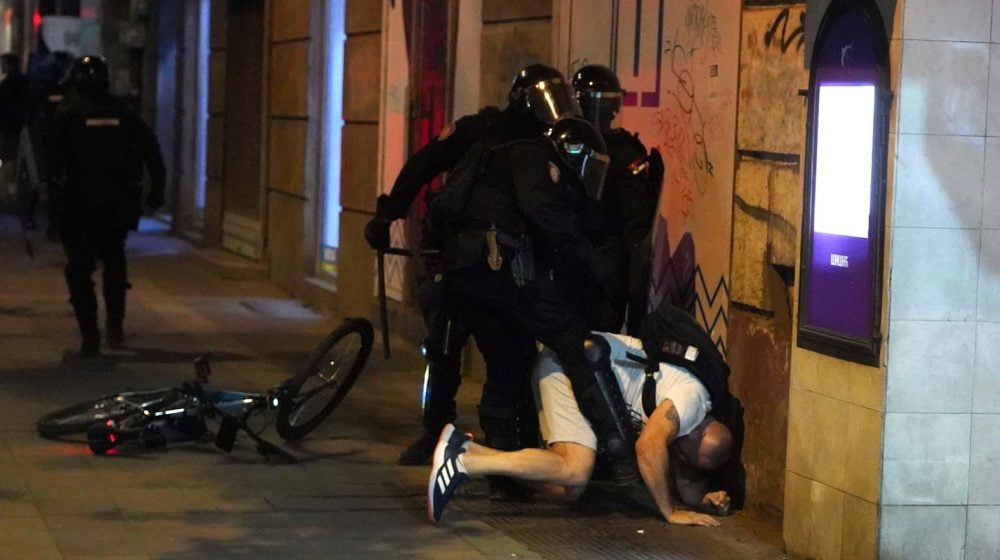
Brutal police crackdown during the June–July unrest (Photo: Antonio Ahel)
June 28 — Vidovdan — is a date that carries profound historical weight in Serbia. On that day in 1389, the famed Battle of Kosovo was fought between the Serbian and Ottoman armies, sealing the fate of medieval Serbian statehood and laying the foundation for the so-called “Kosovo Myth.”
On the same date in 1914, Gavrilo Princip assassinated Archduke Franz Ferdinand. 1948 the “Informbiro” Resolution was issued, expelling Yugoslavia from the Eastern Bloc. In 1989, Slobodan Milošević delivered his infamous speech commemorating the Battle of Kosovo, a pivotal moment in creating his cult of personality. And on June 28, 2001, he was handed over to the Hague Tribunal. In short, it is a date laden with heavy symbolism — and it was precisely for that day in 2025 that students scheduled a new mass protest in Belgrade.
Despite the same kinds of obstructions seen on March 15 — including the suspension of public transport and police blockades — over 100,000 citizens managed to reach Belgrade’s Slavija Square. The rally unfolded peacefully, albeit with the expected right-wing overtones. The students symbolically turned on a green light at the end, signaling that the nation should move toward civil disobedience.
And then, the first incidents followed.
As English readers may already be aware, in an unprecedented move, the government set up a tent encampment in Belgrade’s Pionirski Park — the green area separating the Serbian parliament building from the presidency — and along the roadway directly in front of the National Assembly. The camp was allegedly populated by “students who want to study,” i.e., students opposed to the university blockades.
However, there are hardly any actual students present. The area is occupied primarily by dozens of SNS party activists and loyalists, many elderly, whom President Vučić likely positioned himself, possibly out of concern for his safety while at work.
The camp soon became known as “Ćaciland” — a mocking play on words inspired by an earlier linguistic blunder made by SNS members — and it quickly irritated many Belgraders, including even the city’s SNS mayor, Aleksandar Šapić, whose administration has been unable to complete the long-overdue renovation of the parliamentary square due to the occupation. Soon after, the camp came under formal police protection.
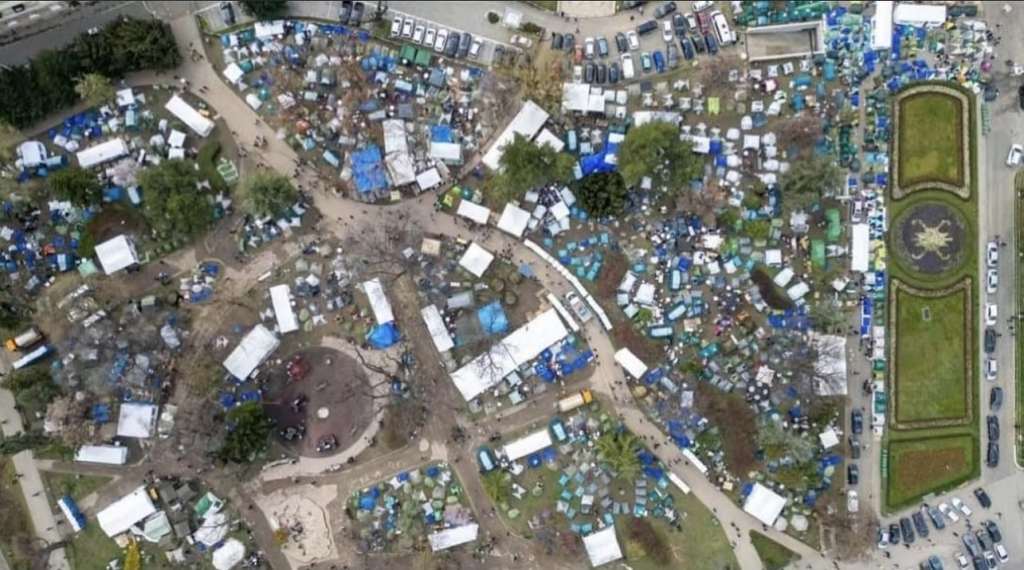
A drone footage of „Ćaciland“ (Photo taken from „Bez cenzure“ portal)
On the evening of June 28, following the student rally, some citizens launched an attack on Ćaciland and were soon confronted by police forces, leading to a serious escalation of violence — including the use of tear gas on one side and pyrotechnics on the other.
In the following weeks, massive street and road blockades erupted nationwide. The most successful one lasted several days and took place in Zemun.
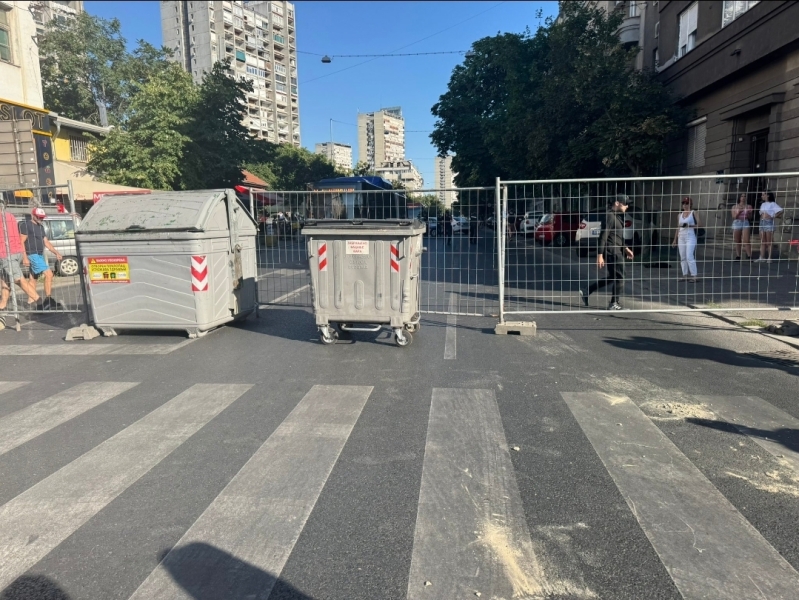
June-July street barricades in Belgrade’s municipality of Zemun (Photo: „Uzvik“/“X“)
Scenes of unprecedented violence were witnessed, especially in Belgrade. At one point, the police stormed the entrance hall of the Faculty of Law — directly violating university autonomy — and arrested dozens of students and gathered citizens.
However, the police managed to end most of these blockades. This is because it is summer, most people are on vacation, and Serbia frequently faces heatwaves, with temperatures reaching up to 40°C.
But does that mean the protests have once again come to an end? No. They have continued daily, albeit with somewhat lower intensity.
And then, at the end of July, came what had long been anticipated.
Polls and local elections
Two polling agencies – “Sprint Insight” and “Nova srpska politička misao” („New Serbian Political Thought“) – successively published two separate public opinion surveys with different questions, which helped clarify some of the regime’s earlier moves (as it is known to conduct its own internal polling in secret).
Both surveys showed that the student list, running independently, is polling better than the entire SNS-led coalition – a result not seen since the summer of 2012.
The results diverge in „Sprint Insight’s“ claim that the student list alone could defeat the government in elections (with about 45% support versus SNS’s 40%—likely enough for an outright majority under Serbia’s electoral system), while „NSPM“ argues that a coalition between the political opposition and students is necessary—something the latter consistently refuses.
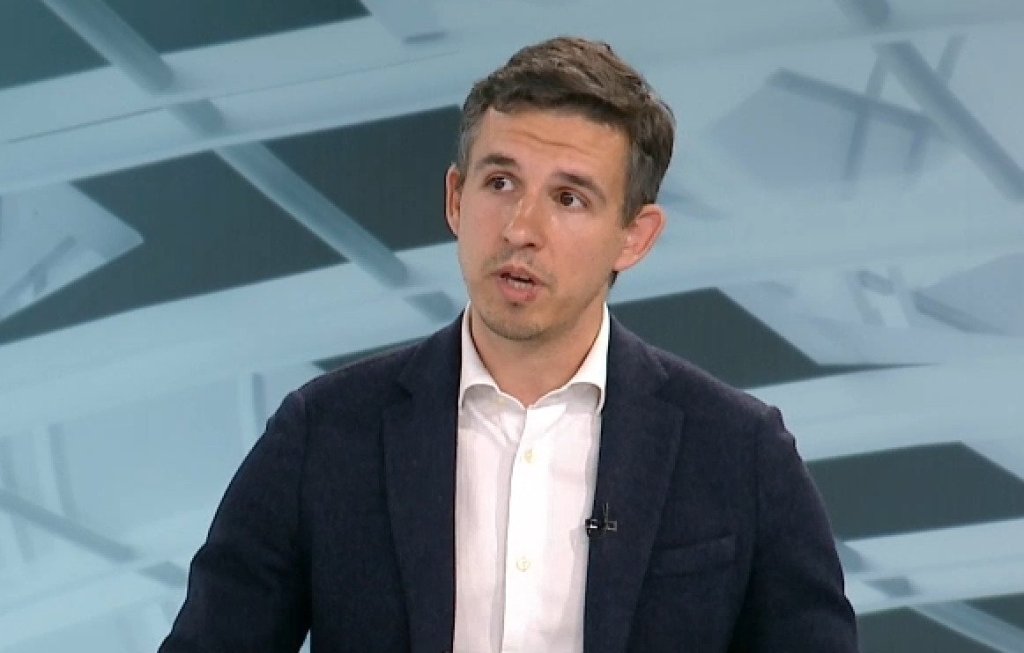
Political scientist Dušan Lj. Milenković, one of the founders of the agency „Sprint Insight“ (Photo: „N1“ TV printscreen)
Both surveys, however, offered one more significant insight: for the first time in more than a decade, a clear majority of Serbian citizens believe the country is heading in the wrong direction.
Although this article aims to provide a global overview of the events unfolding in Serbia, we must also briefly address the June 8 local elections in Zaječar and Kosjerić. These two towns were previously considered strongholds of the SNS (especially the latter).

Philosopher and public opinion researcher Đorđe Vukadinović, one of the founders of „New Serbian Political Thought“ (Photo: „Tanjug“)
However, the situation has shifted: while the SNS defeated the united opposition list (supported by the student movement), it did so by a narrow margin — just five seats in Zaječar and only one in Kosjerić.
This alone suggests that in larger urban areas, the balance of power is very likely tipping in favor of the regime’s opponents.
In response to these surveys, the SNS released its own results that painted a more favorable picture for the regime.
While IPSOS is an international conglomerate, its Serbian branch operates under the government’s firm grip. The news portal Blic published an “IPSOS” poll, which the polling company’s website has not officially verified. According to this survey, the SNS stands at 40%, the opposition is fragmented (with many parties polling below the threshold), and the student list is reportedly at just 5%.
It was later revealed, however, that IPSOS did not even include the student list as a voting option in the survey. Instead, respondents were only allowed to write it in manually if they were dissatisfied with the offered choices. This was justified by the claim that the “student list has not yet been formally announced or registered as a political entity.”
In the following days, the pro-regime agency Faktor Plus also published a suspicious poll, placing SNS at 40%, and the student list at around 8% — though the methodology behind this survey was never clarified.
A new hope or just another farce?
At the beginning of August, a new surprise unfolded. Acting on an investigative judge’s order, former Minister of Infrastructure Tomislav Momirović was arrested due to alleged links to corruption. His successor, Goran Vesić, who had already been detained once before, was also supposed to be taken into custody — but unexpectedly had to undergo emergency appendicitis surgery, and remained in a private hospital for weeks.
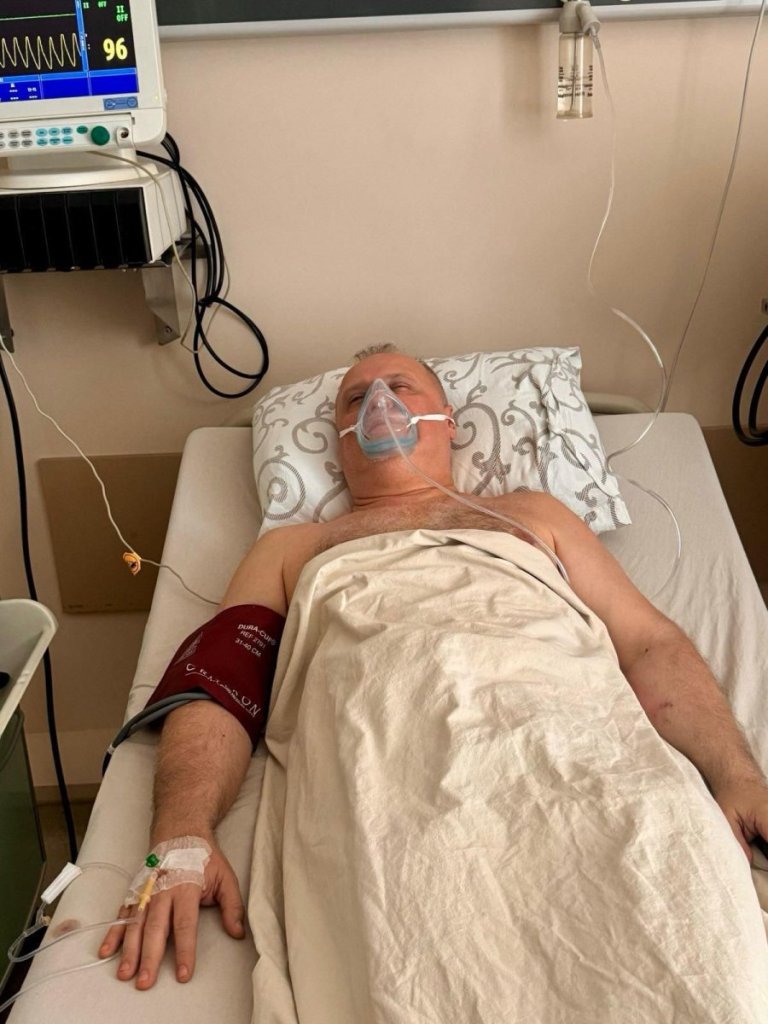
Goran Vesić in hospital (Photo: „Informer“)
Pro-government media immediately accused the responsible judges of attempting a coup. At the same time, the opposition assured the public that this was not just another staged performance, but rather a sign of genuine arrests.
However, a few weeks later, all those detained were transferred to house arrest.
August escalation
While rebellious citizens commented on these pro-regime polls on platform “X” in early August with phrases like “If you’re doing so well, why don’t you call an election?” an unexpected new wave of violence erupted.
For months, the SNS had stationed supporters, party members, activists, and employees of public companies in front of its offices to “defend” them.
On August 11, a minor escalation occurred in Bačka Palanka between demonstrators and this group, with police standing between them. The next day, in Bački Petrovac and Vrbas, SNS-affiliated thugs launched fireworks at citizens, leaving many injured.
The very next evening, almost predictably, the violence spread across the entire country.
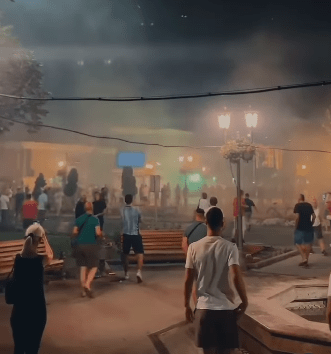
The SNS-thugs launching fireworks at the protesters in Vrbas (Photo: „Serbia Live“ Instagram printscreen)
It is difficult to list all the places where violence escalated between August 13 and 17.
In Novi Sad, enraged citizens first clashed with both the police and SNS thugs at the rear entrance of the local party headquarters. It turned out that members of the „Cobras“ – special military police units tasked with protecting high-ranking officials such as the president or prime minister – were at the scene. To this day, it remains unclear who deployed them. One member of this unit reportedly pulled out a firearm and fired a shot into the air.
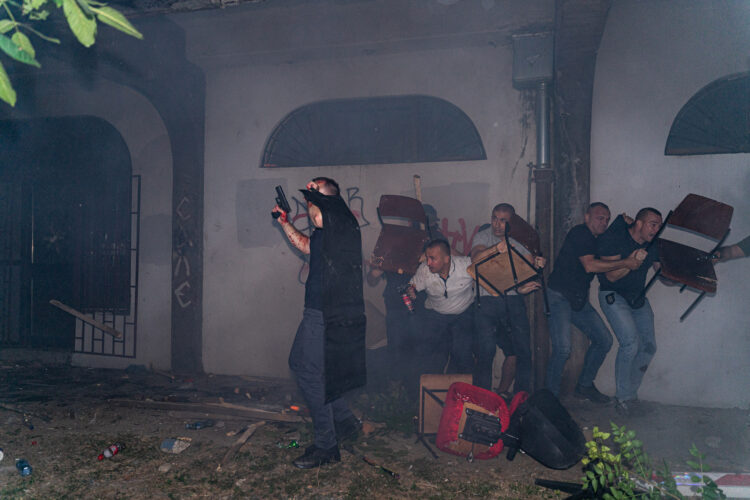
The alleged „Cobras“ units defending the SNS Novi Sad HQ (Photo: Andrej Hložan)
The following day, the public vacated and demolished the premises.
On Friday, August 15, serious incidents took place in the western Serbian city of Valjevo, where police brutally beat several high school students (the health status of some of them remains unknown!).
Enraged citizens retaliated the next day by destroying and burning down the SNS local headquarters (see cover photo).
In both Belgrade and Novi Sad, offices of the Serbian Radical Party – an ultra-nationalist party from which SNS originated and which is currently in coalition with them – were also vandalized.
Even the Socialist Party of Serbia, which has been in coalition with SNS since it came to power, was not spared from attacks.
SNS retaliated by destroying private property and businesses of individuals close to the student movement, while activists attacked businesses belonging to SNS affiliates.
The center of Belgrade was not spared either. Police acted very aggressively in the government district at the corner of Kneza Miloša and Nemanjina streets, deploying large quantities of tear gas. During this action, opposition MP from the SSP party, Peđa Mitrović, was seriously injured.
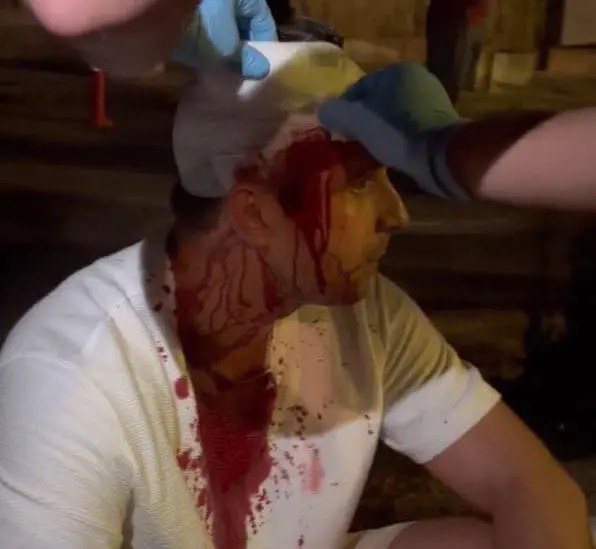
Injured SSP MP, Peđa Mitrović (Photo: SSP)
Student activist Nikolina Sinđelić was detained in the basement of the government building by the Special Protection Unit for High-Security Facilities and Persons, whose commander, Marko Kričak, allegedly threatened her with beatings and rape.

Marko Kričak (Photo: MUP/YT printscreen)
Once this incident became public, pro-government media circulated her intimate photos taken when she was underage.

Nikolina Sinđelić (Photo: TV „Nova S“ printscreen)
This led to new protests – albeit more peaceful in nature.
New waves of arrests and detentions followed: Detention was ordered for the president of the Novi Sad branch of the Movement of Free Citizens, Radivoje Jovović (also arrested some months earlier), several students, and — particularly noteworthy — a medical technician who, after scenes of police brutality in Novi Sad, refused first to treat a slightly injured policewoman, giving priority instead to people whose lives were in danger.
By the beginning of the following week, however, the police had largely managed to contain the violence (albeit through very aggressive measures), and both students and citizens partially withdrew.
Current overview
At the time of writing these lines (Friday, August 22, 2025, evening), the situation is as follows:
Although the violence has seemingly stopped, it is clear that everyone is waiting for the moment it might erupt again. The summer holiday season is closing, and the new school year is set to begin in just over a week. However, it remains uncertain how it will start, given that many teachers — who supported the strikes and blockades — have been dismissed.
The academic year has been postponed to November 1 for now, and all signs suggest that the new generation of university freshmen is even more radical than the previous ones.
Meanwhile, the government is attempting — through covert means — to stage a hostile takeover of the conglomerate United Group (officially headquartered in Luxembourg), which owns key independent media outlets in Serbia: the cable TV channels N1 and Nova S, the daily newspaper Danas, and the weekly Radar. Recently, the cable provider SBB (formerly owned by United Group) was acquired under murky circumstances by the investment fund PPF, which already owns the Serbian telecom operator Yettel — a company known for its willingness to cooperate with the ruling party.
Smaller cable operators like “Orion Telekom” must remove “N1” and “Nova S” from their offerings. Two days ago, a new director — far more amenable to cooperating with the regime — was appointed in one of United Group’s subsidiaries (although not the media branch itself). Recently, the minority shareholder of United Group — Dragan Šolak, who was frequently targeted by pro-government media, was removed from his position as CEO. As a result, he is now engaged in legal proceedings against the majority shareholder.
Just today, Vučić offered the students a televised debate — a curious move, given that he hasn’t participated in any debates for over a decade and has given interviews almost exclusively under strictly controlled conditions. The students mocked the offer and declined.
For now, the protests won’t fizzle out — and both Vučić and his opponents face two paths ahead: elections or civil war.
 Велтшмерц
Postavi komentar